Solo Luck Versus a Pool Credit at 66 TH/s
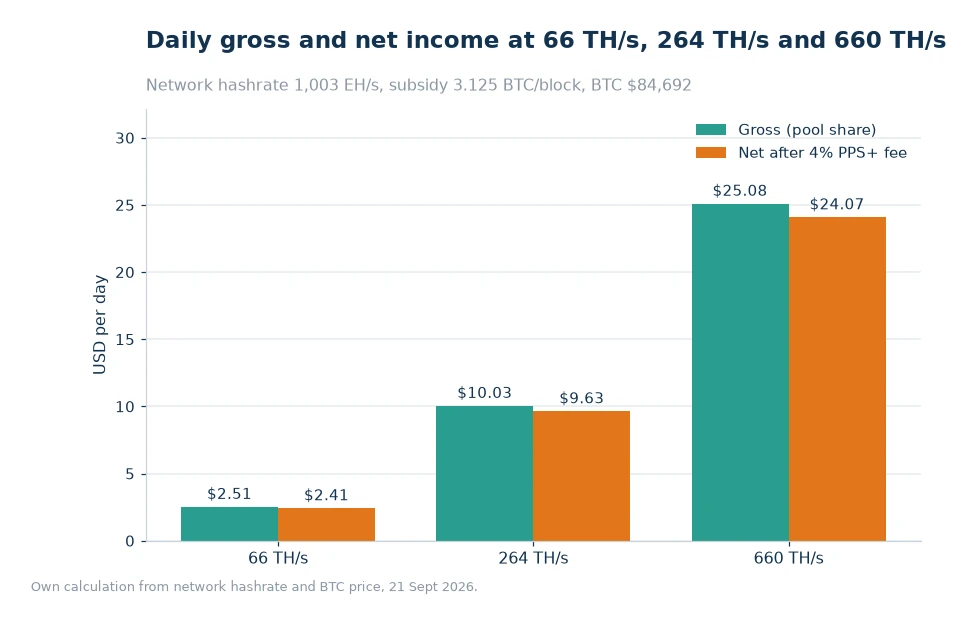
Sixty-six terahashes is 0.0000066% of a 1,003 EH/s network, which means an expected wait of 105,540 days — about 289 years — for a single block found alone. The same machine in a pool credits 2.961e-05 BTC a day, $2.51 gross and $2.41 after the listed charge. Same hardware, same shares, radically different distribution of the reward.
Key takeaways
- At 66 TH/s the expected solo wait for one block is 105,540 days, or roughly 289 years.
- Pooled at the same hashrate, the machine settles 2.961e-05 BTC a day, or $2.41 after the listed 4%.
- Ten times the hashrate cuts the solo wait to 29 years; it does not make solo mining a schedule.
- The pool does not raise expected value, it changes when the value arrives.
The number that ends the solo argument
Mining is a lottery with a very small prize frequency. Each hash is a ticket, and a block is found when one ticket happens to fall below the target. With 144 blocks a day across the whole network, a miner holding a share s of total hashrate should expect 144 × s blocks a day, which is a fraction far below one for any small machine.
Turn the fraction over and you get a wait. At 66 TH/s against 1,003 EH/s, the share is 6.58e-8, so the expected wait is 1 ÷ (144 × 6.58e-8) days, which is 105,540 days. Divide by 365.25 and the answer is 289 years. A machine does not last 289 years, so a solo miner at this size is not buying income; they are buying a ticket that will almost certainly expire worthless.
At that point the honest description is not mining income but a lottery ticket with a very long odds sheet.
Some operators enjoy that. It is a legitimate hobby, and the pool is not the only way to participate. But it should be chosen as a hobby, with the coins treated as spent, rather than entered as a plan for monthly income. The distinction is not moral, it is budgetary: a lottery ticket is paid for once and forgotten, while a machine runs a power bill every day it waits.
Why the average wait is not a schedule
An expected wait is a mean, not a promise. The underlying process is memoryless in the sense that a machine which has run for a year without a block is no closer to one than it was on day one. That feels wrong, and it is the single most common misunderstanding in solo mining: work done does not accumulate toward a guaranteed find, it only buys more tickets.
The variance is brutal at small scale. Even if the expected wait were a decade, the actual outcome could be three decades or three months, and the operator has no way to tell which they are in until it happens. A pool converts that variance into a smaller, steadier stream by pooling everyone's tickets and paying each participant for the tickets they contributed.
That is the whole trade. The expected coins per hash are broadly the same before fees, and the fee is what you pay for the smoothing. Whether it is worth paying depends on whether the operator can fund the gap between blocks, which for a 66 TH/s machine is effectively forever.
It helps to put a probability beside the average. If finds arrive as a Poisson process, the chance of at least one block within the mean wait is about 63%. The chance of waiting less than a tenth of the mean is about 9.5%. For 66 TH/s that tenth is still 29 years, which is the useful way to read the table: even the lucky tail of the distribution sits beyond the life of the hardware.
What the pool does with the same shares
Under PPS+, the block-reward part is settled hourly against current difficulty. The miner is paid for the shares submitted, not for the blocks the pool happens to find, so the pool's luck does not enter the miner's balance. That is why the daily figure is stable enough to budget against, and why the listed rate on that component is 4% rather than 2%.
PPLNS works differently. It waits for six confirmations and then splits the block by each miner's share of the pool's hashrate over the last five difficulty rounds. A miner who joins and leaves frequently is penalised relative to one who stays, and the payout moves with the pool's actual finds. Long-run averages can be higher because the fee is 2% on the combined block reward and fees, but the month-to-month line is bumpier.
For someone stepping away from solo mining, PPS+ is usually the easier first stop because the credit looks like a smaller version of a salary rather than a lottery win. The ViaBTC Crypto Mining account shows both modes and the hourly credit history, which makes the difference visible without a spreadsheet.
Expected wait for a single block
The table applies the same formula at four hashrates. The days column is 1,003,000,000 ÷ (144 × hashrate); the years column divides by 365.25. Nothing here depends on the coin price, because a block is a block regardless of what it is worth in dollars.
| Hashrate | Share of network | Days per block | Years per block |
|---|---|---|---|
| 66 TH/s | 0.0000066% | 105,540 | 289 |
| 100 TH/s | 0.0000100% | 69,653 | 191 |
| 264 TH/s | 0.0000263% | 26,385 | 72 |
| 660 TH/s | 0.0000658% | 10,554 | 29 |
A useful sanity check sits in the second row: 100 TH/s giving about 191 years matches the commonly quoted figure of roughly 190 years for a solo block at that size, which confirms the formula before it is applied to the other rows. The percentages look absurdly small because they are; a home miner is a rounding error against a network measured in zettahashes.
Worked example
Run 66 TH/s through both routes so the comparison is explicit.
- Share of network: 66 ÷ 1,003,000,000 = 0.0000000658, or 6.58e-8.
- Blocks per day expected: 144 × 6.58e-8 = 0.00000947 blocks, roughly one block per 105,540 days.
- Years: 105,540 ÷ 365.25 = 289.
- Pooled daily output: 66 × 0.00000044865 = 0.00002961 BTC, written 2.961e-05.
- Gross value: 0.00002961 × 84,692 = $2.51.
- Listed charge: 2.51 × 0.04 = $0.10, leaving $2.41 a day.
- Thirty days pooled: 0.00002961 × 30 = 0.0008883 BTC, about $75.24 gross and $72.23 settled.
- One block at 3.125 BTC would be worth $264,662, but the expected wait of 289 years means the machine would need to outlive its own replacement several times over.
Frequently asked questions
How long would 66 TH/s take to find a block alone?
About 105,540 days, or 289 years, because 66 TH/s is 0.0000066% of a 1,003 EH/s network and the network finds 144 blocks a day; the figure is an average, not a schedule.
Does pooling increase the coins I earn?
It does not increase the expected coins per hash before fees; it changes the timing, paying a steady hourly credit instead of an almost never-ending wait, and the listed 4% on the block-reward component is the cost of that smoothing.
What is the difference between PPS+ and PPLNS here?
PPS+ pays hourly against current difficulty and ignores pool luck, while PPLNS pays after six confirmations and shares each block across the last five difficulty rounds, so PPLNS varies more month to month.
Pick the variance you can live with
The honest question is not which method pays more in theory but which one the household or the business can fund through a bad stretch. An operator with a power bill due every month needs the hourly rhythm; an operator with capital and patience may prefer the lower listed rate on the combined PPLNS pool. The pool state page shows how the pool is performing against expectation, and the Profit Calculator gives the daily figure at your hashrate so the two routes can be compared with numbers rather than adjectives.
Sources: ViaBTC settlement, calculator and pool-state pages[1]. Read 21 Sept 2026: 1,003 EH/s network, 132.76 T difficulty, 144 blocks a day paying 3.125 BTC each, BTC $84,692. Published 24 Oct 2026. Expected waits assume today's difficulty forever, which it will not be.